Shockwave Therapy for Persistent Tendon and Heel Pain: What It Does—and What It Doesn't

Dr. Seneque Milien performing shockwave therapy on a patient's shoulder at Precision Primary Care and Wellness in Fishers, Indiana
If you have lived with heel, elbow, shoulder, knee, or Achilles pain for months, the hardest part is often not the pain itself. It is the way the pain slowly takes things away.
You stop walking as far. You avoid the stairs. You change your workout. You give up the shoes you like. You hesitate before picking up your child, serving a tennis ball, or planning a trip that will require too much time on your feet.
You may already have tried rest, stretching, ice, anti-inflammatory medication, new footwear, or physical therapy. Some of those steps may have helped temporarily. Then the pain returned as soon as normal life resumed.
Why Tendon and Plantar-Fascia Pain Can Persist
Tendons connect muscle to bone and must repeatedly tolerate pulling and loading. The plantar fascia supports the bottom of the foot and absorbs stress with standing, walking, and running.
Unlike Muscle tissue which has a rich blood supply and can heal in a couple of weeks, Tendons and fascia are far less vascular — blood flow to these tissues is limited by design. When they're injured, they often don't get the raw materials (oxygen, nutrients, repair signals) they need to heal efficiently on their own. The result is chronic, low-grade tendinopathy or fasciitis that can drag on for months, sometimes years, resistant to rest and stretching alone.
This is exactly the problem shockwave therapy is designed to address.
What Shockwave Therapy Actually Is
Extracorporeal shockwave therapy uses focused acoustic pressure waves delivered through the skin to the affected tissue. The mechanism has a few distinct effects:
- Increases local blood flow to a tissue that's normally underserved by circulation, giving the body's own repair processes more to work with
- Breaks down calcific deposits and disorganized scar tissue that can form in chronically injured tendons
- Stimulates a controlled micro-inflammatory response, which sounds counterintuitive but is actually what re-triggers the healing cascade in tissue that's become stuck in a chronic, non-healing state
In plain terms: it's not masking pain, it's attempting to restart a healing process that stalled.
What It Treats
Shockwave therapy has the most established evidence for:
- Plantar fasciitis
- Achilles tendinopathy
- Tennis elbow (lateral epicondylitis) and golfer's elbow
- Patellar tendinopathy ("jumper's knee")
- Chronic shoulder tendinopathy, including calcific tendinitis
- Certain cases of vascular
-Greater trochanteric pain syndrome on the outside of the hip
Why Exercise and Load Management Still Matter
Shockwave does not correct every reason a tendon became overloaded.
If heel pain is being driven by a sudden training increase, limited ankle mobility, inadequate footwear, reduced calf strength, or prolonged standing, those factors still matter. If elbow pain comes from work technique or repeated gripping, treating the painful spot without changing the load may lead to another flare.
For many tendon problems, progressive strengthening and load management remain central to recovery. Shockwave may be added to support pain reduction and function—not used as permission to ignore rehabilitation.
The goal is not simply to make a painful spot quieter for a day. It is to help you return to activity with a plan the tissue can tolerate.
The Precision Difference: Evaluate First, Treat Second
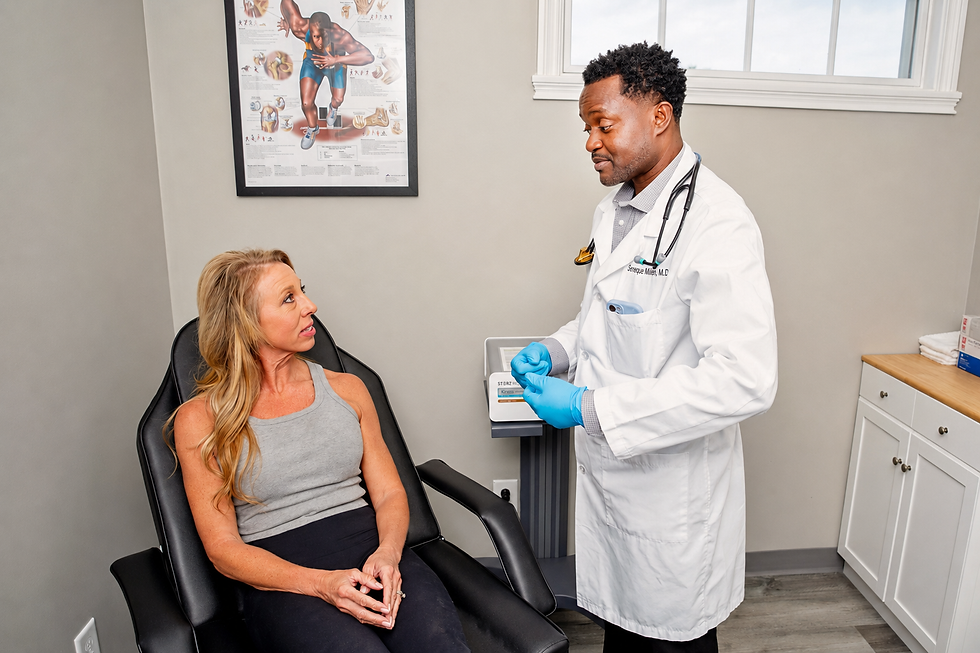
[Dr. Seneque Milien discussing a pain and recovery plan with a patient in Fishers, Indiana](images/shockwave-pain-evaluation-precision-fishers.jpg)
At Precision Primary Care & Wellness, the first question is not, “Where should we put the applicator?” It is, “What is most likely causing this pain?”
A focused evaluation may include:
- How and when the symptoms began
- The movements or loads that make the pain worse
- Strength, range of motion, tenderness, and functional testing
- Previous therapy, injections, imaging, or surgery
- Medical conditions and medications that may affect healing or safety
- Whether an X-ray, ultrasound, MRI, physical-therapy plan, or specialist referral is more appropriate
What a Shockwave Appointment Feels Like
At Precision, shockwave appointments are scheduled for approximately 30 minutes, including assessment, preparation, treatment, and aftercare guidance. The active delivery of pulses may occupy only part of that appointment, depending on the area being treated.
Gel is placed on the skin to help transmit the mechanical energy. The applicator is then moved over the targeted tissue. Most patients describe a rapid tapping or pulsing sensation. It may be mildly uncomfortable or moderately intense over a sensitive area, but the intensity can usually be adjusted.
The goal is not to prove that you can tolerate the highest setting. More discomfort does not automatically mean a better result.
Temporary soreness, redness, mild swelling, or bruising can occur after treatment. Your activity guidance will depend on the diagnosis, treatment location, and rehabilitation plan.
How Many Sessions Will I Need?
There is no universal number that fits every condition or device. Many clinical protocols use a short series of treatments—often several sessions separated by approximately one week—but the appropriate plan depends on the diagnosis and response.
Some patients notice early symptom change. More durable improvement, when it occurs, may develop over several weeks as pain, loading capacity, and function change. Shockwave should not be sold as an instant fix.
At Precision, progress is measured by function as well as pain:
- Can you walk farther?
- Can you tolerate stairs better?
- Can you return to exercise gradually?
- Is morning heel pain changing?
- Are strength and movement improving?
If there is no meaningful progress, the answer is not an endless series of sessions. It is time to reassess the diagnosis and plan.
Who Should Be Screened Carefully Before Treatment?
Shockwave therapy is noninvasive, but that does not mean it is appropriate for every person or every body area.
Tell the clinician before treatment if you have:
- Pregnancy, particularly when the fetus could be in or near the treatment field
- A tumor, active infection, or open wound in the proposed treatment area
- A bleeding disorder, significant bruising tendency, or anticoagulant use
- A pacemaker, implanted defibrillator, or other device near the treatment field
- A suspected fracture, acute tendon rupture, or recent operation
- Reduced sensation that could make it difficult to judge treatment intensity
- A child or adolescent with an open growth plate near the proposed treatment area
Contraindications and precautions vary by the device, energy level, and treatment location. Do not stop prescribed blood thinners or other medication on your own; the clinician should determine whether and how treatment can be performed safely.
What Shockwave Therapy Does Not Do
Shockwave therapy does not:
- Diagnose the cause of pain
- Replace urgent evaluation of a fracture, infection, acute rupture, or neurologic deficit
- Correct footwear, technique, strength, or loading problems by itself
- Guarantee tissue regeneration
- Work equally well for every condition
- Mean that rehabilitation is no longer necessary
- Guarantee that surgery, injections, or other treatment will never be needed
The right promise is not “this will fix everyone.” The right promise is that the treatment will be recommended selectively, the expected benefits and uncertainties will be explained, and the plan will be reassessed honestly.
Frequently Asked Questions
Is shockwave therapy the same as an electrical shock?
No. It uses mechanical acoustic or pressure-wave energy delivered through the skin. It does not send an electrical current through the painful tissue.
Does shockwave therapy hurt?
The tapping or pulsing can be uncomfortable over a sensitive area, but settings can usually be adjusted. Treatment should be tolerable and guided by communication—not by the assumption that maximum discomfort produces maximum benefit.
Is one session enough?
Usually, shockwave is evaluated as a series rather than a one-time cure. The number and spacing of sessions depend on the condition, device, response, and rehabilitation plan.
Can shockwave therapy treat neuropathy?
Yes, but in the right setting. At Precision, we look for the underlying cause first. Burning, numbness, or tingling deserves an evaluation for causes such as diabetes, vitamin deficiency, medication effects, nerve compression, or spinal disease before a device-based treatment is recommended.
What about shockwave therapy for erectile dysfunction?
Low-intensity shockwave treatment for erectile dysfunction remains investigational in American Urological Association guidance. Precision does not present this as established routine therapy. This is not offered at our facility at this time.
Where can I find shockwave therapy near Indianapolis?
Precision Primary Care & Wellness provides physician-guided shockwave therapy in Fishers, Indiana, serving patients from Fishers, Carmel, Noblesville, Westfield, Geist, and the greater Indianapolis area.

[Precision Primary Care and Wellness sign outside the Fishers, Indiana clinic](images/precision-shockwave-therapy-near-indianapolis.jpg)
Ready to Find Out Whether Shockwave Fits Your Pain?
If pain has been limiting your walking, exercise, work, or recovery, the next step should not be another generic promise. It should be a clear evaluation of what is causing the problem and whether shockwave belongs in the plan.
Precision Primary Care & Wellness is located in Fishers, Indiana, with convenient access from Carmel, Noblesville, Westfield, Geist, and Indianapolis.
About the Author
Seneque Milien, MD, is the founder of Precision Primary Care & Wellness in Fishers, Indiana. He is board-certified in Family Medicine and Obesity Medicine and brings more than a decade of hospitalist and medical-director experience to prevention, pain evaluation, recovery, and physician-guided wellness care.
Medical Disclaimer
This article is for general education and is not a diagnosis or a substitute for individualized medical care. Shockwave protocols, risks, contraindications, and expected results depend on the condition, device, treatment area, and patient. Seek prompt medical evaluation for significant trauma, rapidly worsening pain, fever, weakness, loss of function, new numbness, or suspected tendon rupture.
Medical Review Sources
- [Mayo Clinic: Shockwave treatment—a new wave for musculoskeletal care](https://www.mayoclinic.org/medical-professionals/physical-medicine-rehabilitation/news/shockwave-treatment-a-new-wave-for-musculoskeletal-care/mac-20590258)
- [NICE: Extracorporeal shockwave therapy for refractory plantar fasciitis](https://www.nice.org.uk/guidance/htg200)
- [NICE: Extracorporeal shockwave therapy for Achilles tendinopathy](https://www.nice.org.uk/guidance/htg426)
- [Academy of Orthopaedic Physical Therapy: Heel Pain—Plantar Fasciitis Clinical Practice Guideline, 2023](https://www.orthopt.org/uploads/content_files/files/Heel_Pain_Plantar_Fasciitis_Revision_2023.pdf)
- [International Society for Medical Shockwave Treatment: Indications and contraindications](https://shockwavetherapy.org/indications/)
- [American Urological Association: Erectile Dysfunction Guideline](https://www.auanet.org/guidelines-and-quality/guidelines/erectile-dysfunction-%28ed%29-guideline)


Comments